A possible new dwarf planet appears beyond Pluto: what is known about 2026 ED138
Astronomers found a dwarf planet on the outskirts of the solar system, beyond Pluto, thanks to the newly inaugurated Vera Rubin Observatory in Chile.
The Solar System could have a new member on its official list of dwarf planets. Scientists identified a large icy object orbiting beyond Pluto that, based on its preliminary characteristics, could become one of the largest bodies in this category known so far.
The object, provisionally designated 2026 ED138, was detected thanks to the Vera C. Rubin Observatory, located on Cerro Pachón, Chile. Initial calculations place its diameter at between approximately 600 and 1,500 kilometers, although astronomers still need to determine its size more precisely before officially establishing its nature.
2026 ED138 is even farther from the Sun than Pluto
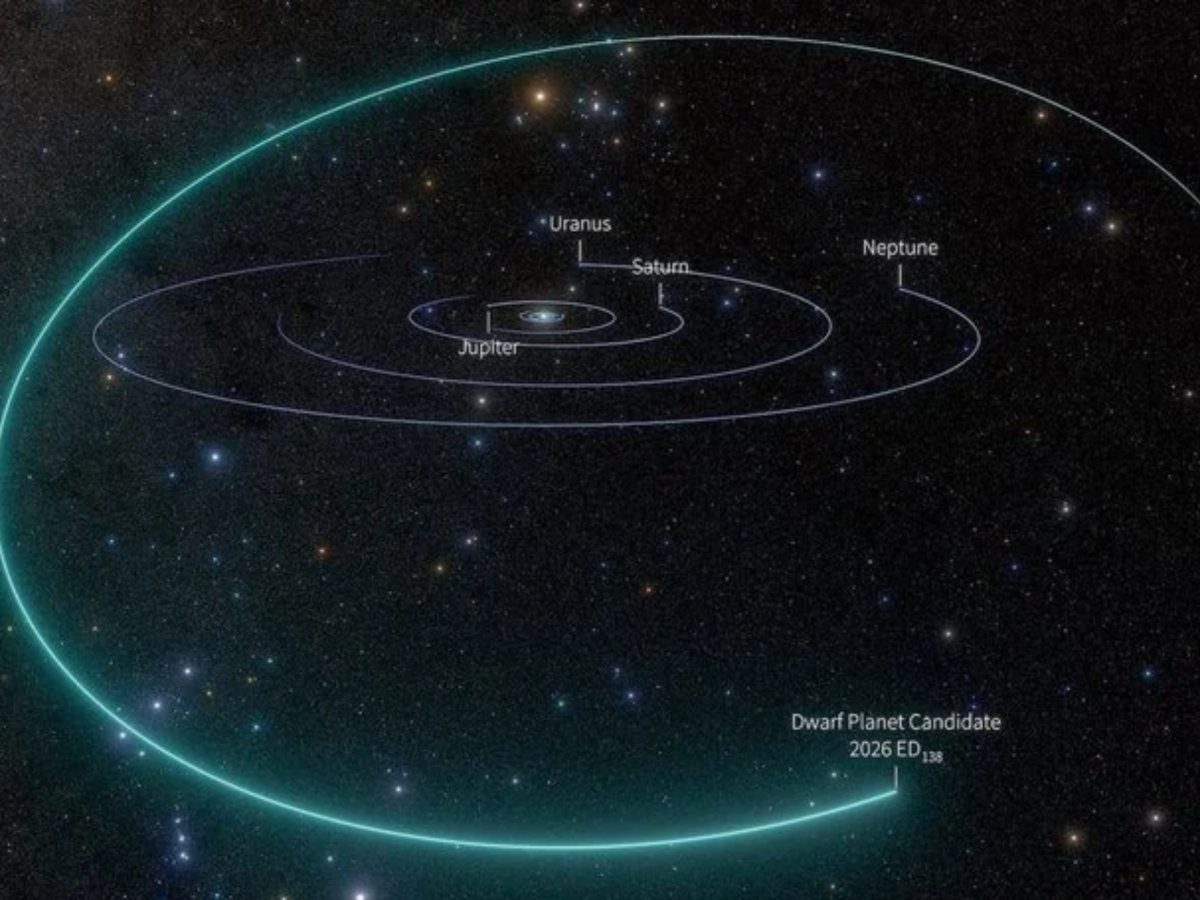
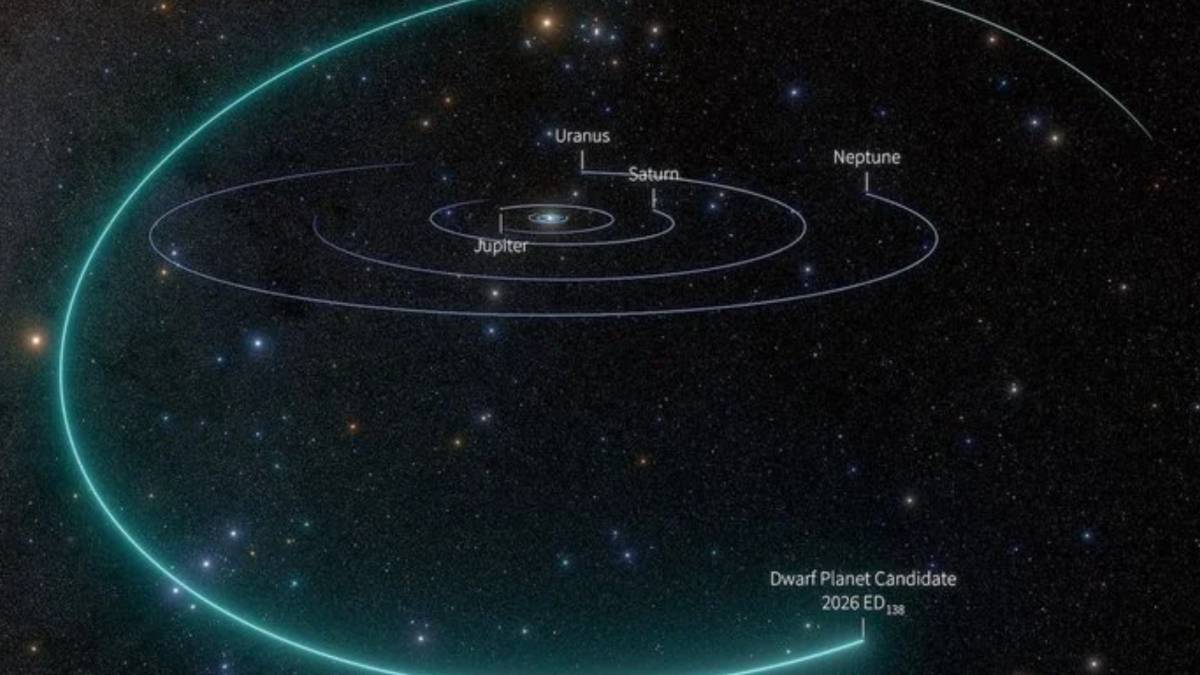
According to the researchers, the new planet, is currently located at a distance from the Sun equivalent to about 46 times the separation between the Earth and our star. By comparison, Pluto orbits at an average distance close to 40 times the one separating the Earth from the Sun.
The discovery was made possible thanks to Rubin's ability to continuously observe large expanses of the sky . The object was located in an area near the plane of the Milky Way, filled with millions of stars, a circumstance that would previously have made its detection difficult. The observatory's systems were able to identify its movement against that enormous stellar background.
Matt Holman, an astrophysicist at the Center for Astrophysics | Harvard & Smithsonian and the one who identified the object, stated that the discovery shows that there are still numerous bodies yet to be found in the most distant regions of the Solar System. The next step will be to establish the physical size of ED138 with greater precision.
The main thing we need to do is establish the physical size of 2026 ED138
What is missing for it to be considered a dwarf planet?
To officially receive that classification, a body must have enough mass for its own gravity to give it an approximately spherical shape.
Available data indicate that 2026 ED138 could meet that condition, but scientists still do not have the measurements needed to confirm it.
One of the problems is that Rubin mainly observes sunlight reflected by the object.
A small but highly reflective body can appear as bright as a larger one with a darker surface. That is why researchers hope to turn to observations at other wavelengths, including the possibility of using ALMA, also located in Chile, to better understand its dimensions.
If it is ultimately classified as a dwarf planet, 2026 ED138 would join the five currently recognized by the International Astronomical Union: Ceres, Pluto, Haumea, Makemake, and Eris. Pluto was part of the list of planets in the Solar System for decades until it was reclassified as a dwarf planet in 2006.
The discovery also reinforces expectations surrounding the Vera C. Rubin Observatory, which began revealing thousands of new Solar System objects during 2026.
In April alone, the observatory reported data corresponding to more than 11,000 new asteroids, a sample of the potential of its observations to discover bodies that had until now gone unnoticed.